Marc Ulrich
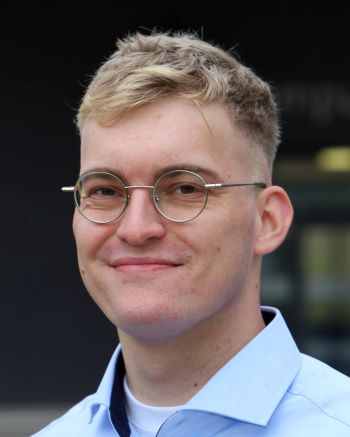
M.Sc. Marc Ulrich
Chair of Computational Mechanics
Mechanik (IWTM), Professur Numerische Mechanik, Otto-von-Guericke-Universität
Magdeburg
2021 - 2024 Master of Science (M.Sc.): Maschinenbau, Otto-von-Guericke-Universität
Magdeburg, Vertiefung: Produktentwicklung - Konstruktion und Berechnung
Masterarbeit: Untersuchung von Homogenisierungsmethoden zur Model-
lierung des Materialverhaltens von Elastomer-Blends
2017 - 2021 Bachelor of Science (B.Sc.): Verfahrenstechnik, Otto-von-Guericke-Universität
Magdeburg
Current projects
Micromechanical material modelling of Thermoplastic Vulcanizates (TPV)
Duration: 01.10.2024 to 30.09.2028
Thermoplastic Vulcanizates (TPV) are of high interest for tailoring materials with specific mechanical behavior. However, while for the pure components the experimental characterization of the temperature dependent viscoelastic properties is usually well feasible, doing this for the TPV is often difficult or impossible. One reason is that the TPV components often have different glass transition temperatures which makes the resulting behavior quite complex. In most cases when blending elastomers and thermoplastics, heterogeneous morphologies are formed consisting of different regions with (nearly) pure components and finite interphases in between. Additional to the pure phases, especially these interphases influence the resulting viscoelastic properties significantly. For such cases, material modeling and numerical simulations can help to better understand the interactions between phases and interphases and to forecast the resulting viscoelastic properties. In this contribution we model and simulate an RVE of a binary blend consisting of rubber (e.g. EPDM) and thermoplasitc (e.g. PP). A phase field variable is used to describe the morphology within the simulation. The morphology is based on microscopic images and the dependency on the field variable is derived from an energy formulation allowing sharp and diffuse interphases between the elastomer and thermoplastic phases. Both, sharp and different diffuse interphases are numerically investigated and their influences on the mechanical behavior are compared to elaborate experiments.